Day 5.
The power went first. Then the water pressure. Then the last bar on your phone.
And when Waffle House closed down, you knew that shit had really hit the fan.
The radio in the kitchen plays nothing but static. Outside, the street is too quiet, and then, after dark, not quiet enough.
Someone you love is in another city. Someone else was on the road when it started. You do not know if they are safe. You do not know if they are coming. You cannot ask, and nobody can tell you.
TesseraMesh is built for exactly that day.
The group survival stack: your own infrastructure for when things really go pear shaped. An Android app, a radio the size of a matchbox, and a plan that everyone already carries.
The idea
Everything you use to reach the people you love belongs to someone else. The towers, the cables, the servers, the app. It all works beautifully until the day it does not, and on that day it fails for everyone at once.
Bring your own network
Small radios that talk to each other directly, with no tower, no provider and no bill. They are cheap, they run for days on a battery, and nobody can switch them off but you.
Say it in bytes
Those radios carry almost nothing. So the system sends only the few things that matter: I am alive, I am here, I need help, do this now. Each of them fits in less space than this sentence.
Carry the plan
The most important message is the one you never have to send, because everyone already has it. Where we meet. Which way we come. What we do if we hear nothing. It keeps working when the radios fall silent.
A tessera is a single tile in a mosaic. In the Roman army it was also the small tablet that carried the night's watchword from unit to unit. One tile is nothing much. Six of them, each in its place, make a picture.
What you carry
Two things. Your own Android phone, with the app. And a tracker: a radio the size of a matchbox, with its own battery and its own satellite receiver.
The phone is the screen. The tracker is the voice. They talk over Bluetooth, so the tracker rides in a pocket or on a pack strap.
The trackers need no network, no provider and nobody's permission. They talk to each other directly, over a radio called LoRa that carries a whisper for kilometres on almost no power. Small solar repeaters on high ground pass the whisper on over ridges and across valleys.
There is a catch, and the whole design grows out of it. This radio carries almost nothing. No photos, no voice. So TesseraMesh learns to say a great deal with very little. "I am fine" costs a handful of bytes. Everything else was put on your phone long before you needed it.
To begin with: the Signaculum
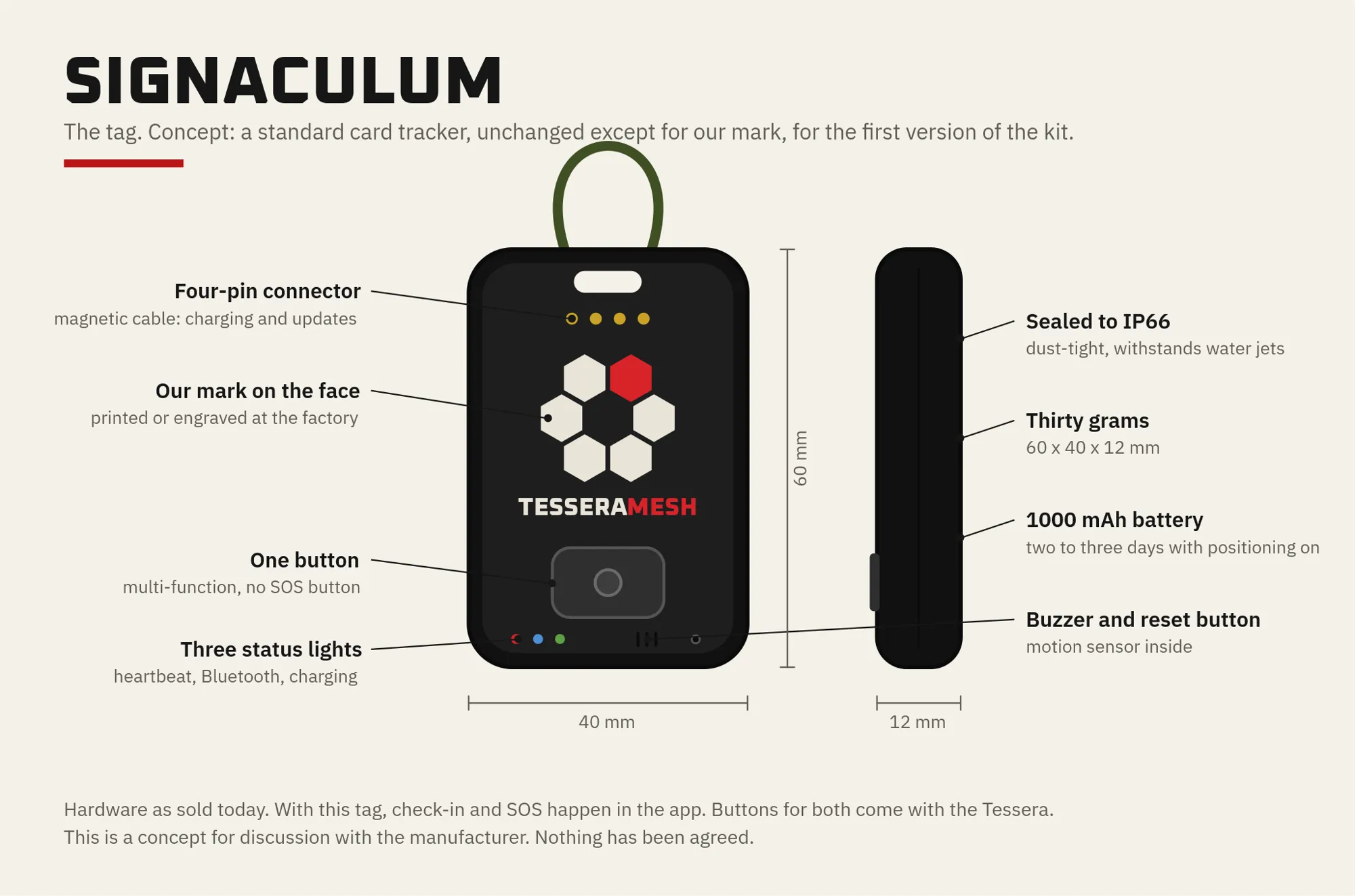
A tag you can buy, the size of a bank card. Thirty grams, sealed against dust and rain, a battery that lasts two to three days, and a single button. With this tag, checking in and calling for help happen on the phone. The aim is a small batch with the six tiles on the face and our settings already loaded, so a group gets six tags and an app, and not a shopping list.
Later: the Tessera
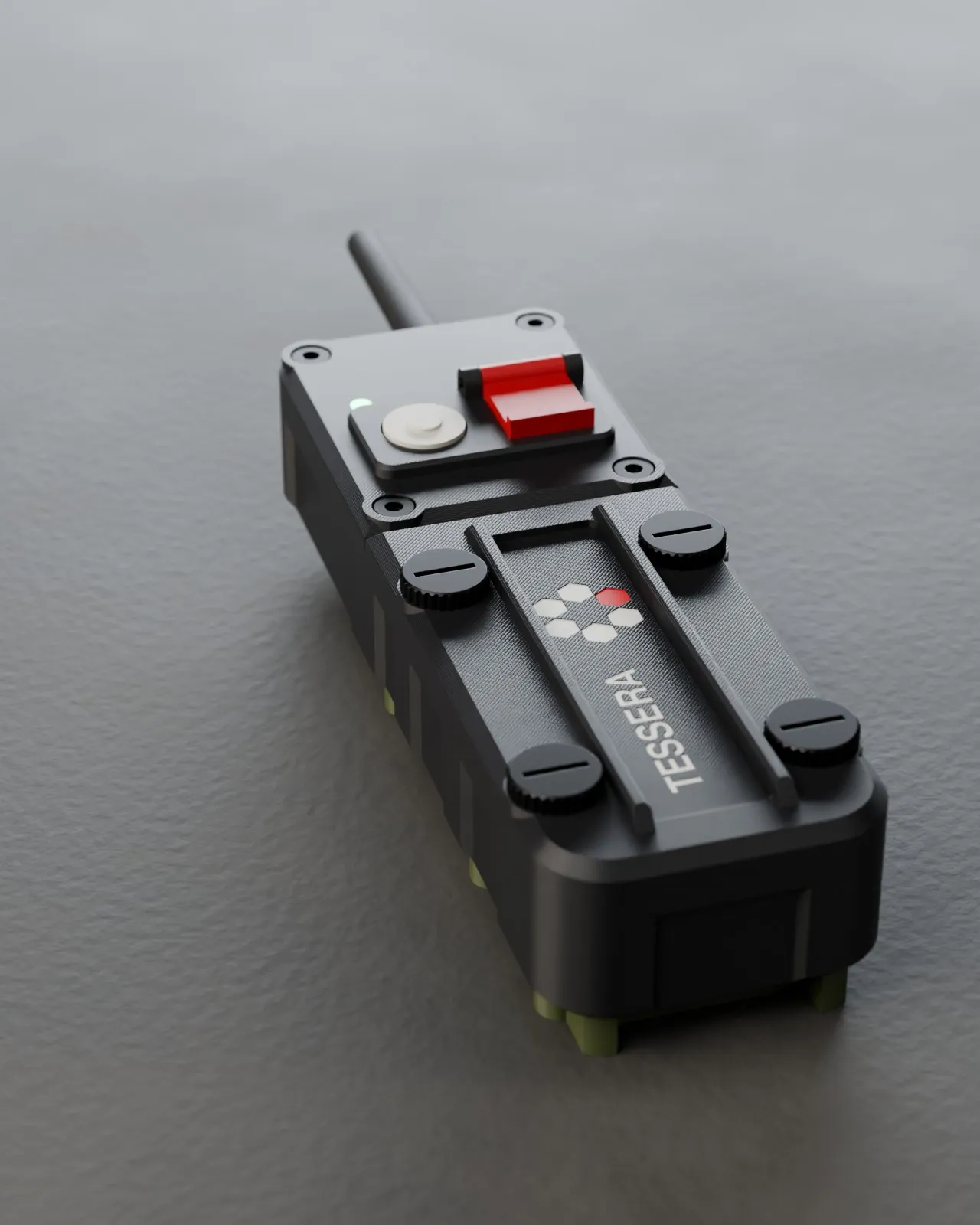
Our own. One button to check in and a guarded one for SOS, both usable with gloves, and both working when your phone is dead. A battery you swap in the field. A real antenna. A mount that puts it high on a pack strap. It can buzz instead of beep, and its one light can be switched off when you would rather not be seen.
It is designed to be sealed against a metre of water, to survive a drop onto concrete and to work from twenty below to sixty above. Those are design targets. The case exists as a printable design, and you can download it.
Four colours
TesseraMesh does not want your attention when life is normal. A system that nags in good times gets switched off, and then it is not there in bad ones. So your group is always at one of four levels, and the level decides how much is asked of you.
Green
All is well.
One tap a month, and nothing else.
Yellow
Something is coming.
You carry the tracker and check in once a day.
Orange
It has happened.
The plan runs the day.
Red
It has reached you.
Everything is on.
Anyone can raise the level by one step. Lowering it takes the coordinator, or two of you agreeing. A false alarm costs a little battery. A missed one costs far more.
A level never comes alone. It carries a trend, steady or rising. It carries a hazard, such as storm, grid, flood or unrest, which decides which playbook you are offered. And it carries a region, because one of you may be in trouble while the rest are fine.
Green
The afternoon that decides everything
All is well. Your tracker sits in a drawer, charged. Once a month there is a roll call: one tap, ten seconds, and everyone knows the batteries are full and the plan is current. That is all.
But green is where everything is decided. None of this works unless your group has spent one quiet afternoon on it. Coffee, cake, a laptop, and every phone on the table. Three things happen at that table, and a fourth on a hill.
First you write the plan.
Not on a phone. At a desk, in the plan studio, a page in your browser that needs no internet. It interviews you, and it asks the questions people skip. Who belongs to us? Where do we meet? Which way does each of us come? And the big one: what does everyone do if nobody hears anything for two days? What comes out is the group's memory: your places, your routes written as route cards with landmarks and walking times, your playbooks, your check-in times, your own short list of status words, and a library of the things you will wish you had read.
Then you exchange keys.
Everyone holds up a phone and scans a code from another. That is the whole ceremony, and the one who runs it is the Tesserarius, the keeper of the watchword. From this moment only these phones can read what the group says. No secret ever travels by radio, so there is nothing in the air for anyone to record today and crack tomorrow.
Then everything gets loaded.
Maps, plan and library go from phone to phone, by cable or local Wi-Fi. A readiness check names names: this one still has no maps, that one has not paired a tracker. Fix it now, because later you cannot.
Finally you climb a hill.
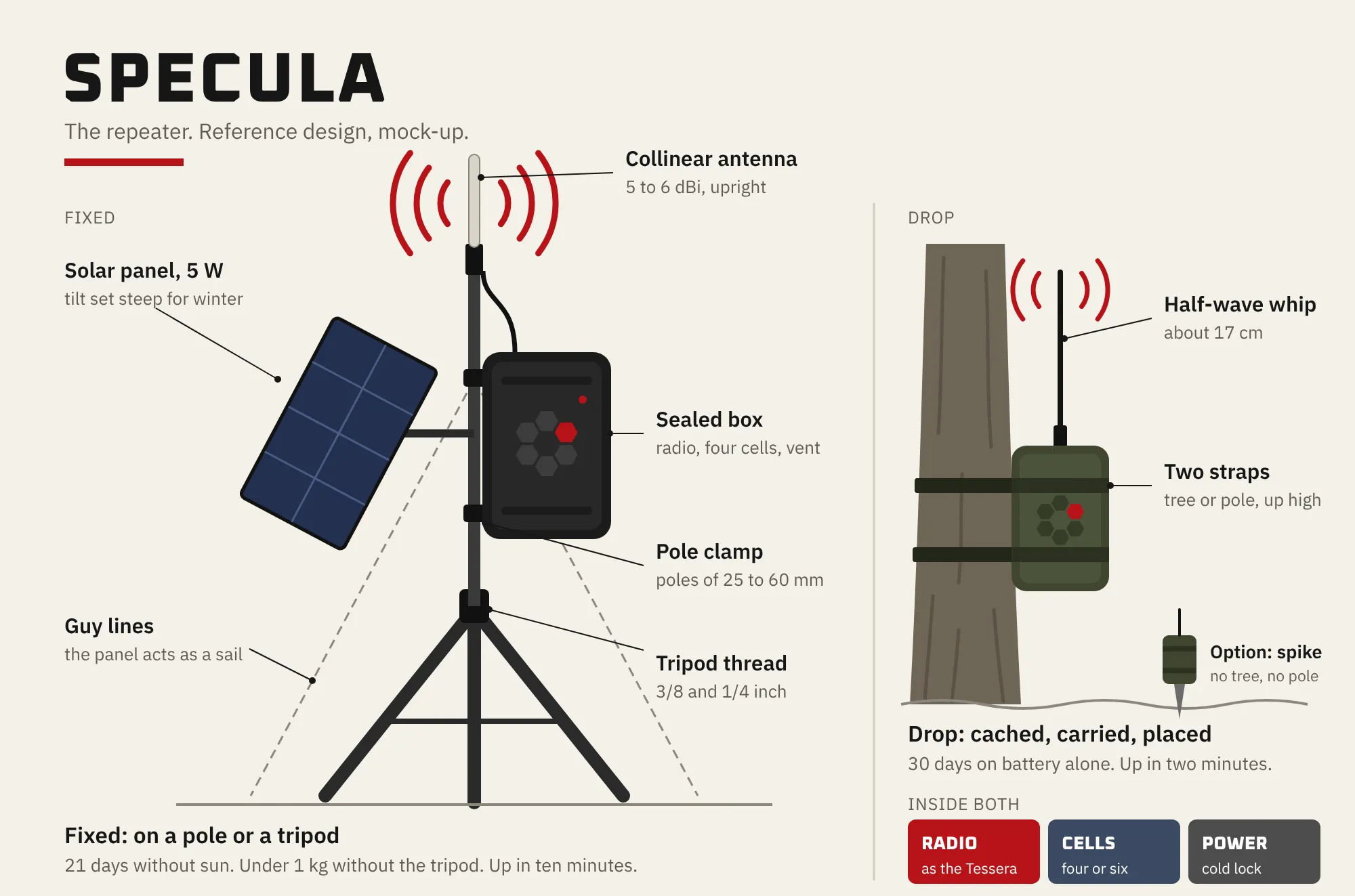
A Specula, our repeater, is a box the size of a lunchbox with a small solar panel and one upright antenna. It wants height and a view. Clamped to a pole on a roof, or standing on a tripod on the ridge behind the village, it can turn a few kilometres of reach into tens. It has no buttons and nothing to operate. You put up one, perhaps two, and mark them on the map.
Then you go home and forget about it. That is allowed. It will be there.
Almost forget. Once a month comes the roll call, and once or twice a year you take the whole thing for a walk. A hike with the trackers switched on is the best exercise there is, and the only way to learn where your radios really reach.
Yellow
Something is coming
And you can smell it. The river is a hand's width below the top of the dyke and still rising. Half the state has had no power since Tuesday, and the minister on television is lying badly. The shelves are stripped, the cash machines are empty, and the fight at the petrol station ended with an ambulance. Your neighbour is loading his car at two in the morning. Nothing has happened to you. Yet.
This is the moment most people waste, because nothing forces them to act. Yellow exists to make you act while acting is still easy.
You take the tracker out of the drawer. You charge everything that has a battery. You do what the playbook for this hazard says, which may be as dull as filling the car and the water canisters. And from yellow upwards you open the app for five seconds a day.
The board
Every name in the group, and next to it the last status, how long ago it came, how old the last position is, and how much battery the tracker has left. One glance. Everyone there? Good.
The check-in
Telling the group how you are, with a single tap. You write nothing. You pick one of a few ready-made messages your group agreed on beforehand: I am OK, I am on the move, I have reached the meeting point, I will be out of touch for a while. Miss one, and your name is highlighted on everyone else's phone. There is no typing, because cold fingers and fear are bad at typing.
The map
It needs no network. It shows each person where they were last heard, and says honestly how old that is. It shows your places, your routes, and the markers people dropped on the way. If someone walks into or out of a place you fenced, such as the camp, you are told.
Positions, sparingly
Every quarter of an hour when moving, once an hour when still. Airtime and battery are the two things you never get back. When you need a fresh position, you ask for it.
The Explorator
An optional watchman. While the internet works, a small service reads the official warnings and the news for your regions and says: suggest yellow, and here is why. Two sentences and its sources, and you tap yes or no. It advises. It never decides. It may suggest going up a level. It never suggests standing down.
The neighbours' colour
If your group is connected to another, you see their colour too. When the farm up the valley goes to orange, that is worth knowing.
Orange
It has happened
The phone has shown no network for a day. The taps cough air. The freezer is thawing, and the whole street smells of it. In the first hours there were sirens. Now there are none, because nobody is coming. Someone has kicked in the door of the pharmacy. Two streets away a person screams for a long time, and you do not go to look.
Nobody had to tell you that this is orange. If the networks die while your tracker is still in the drawer, your phone notices. After six hours without signal it says so, and tells you what the plan says: switch on, go to orange.
Everyone reaches the same level by the same rule, without a single message passing between you. From here on the plan runs the day. Check-ins come at fixed times. Positions go out. A missed check-in starts a clock.
The plan takes over
Someone starts a playbook. One short message, and every phone shows the same thing: the steps, the meeting point, the route, the time by which to be there. Your mother and your fourteen-year-old see exactly what the coordinator sees. Nobody has to explain anything over a bad connection, because there is nothing left to explain.
Small corrections fly the same way: bridge closed, meeting point moved, danger here. Every map follows, and the board shows who is still on yesterday's plan.
When someone goes silent
Radio ends somewhere. Sooner or later one of you is beyond it. This is the moment TesseraMesh was designed for first.
The plan does not need contact
Each phone shows a timeline: given how long we have heard nothing, the plan says this. The one walking alone for five days knows where to be and by when. The ones waiting know it too. Nobody has to guess what the other will do, and guessing is how people lose each other.
Route cards
You do not need a blue dot to find the way. At the chapel, left and uphill, twenty-five minutes to the ridge. No satellites. No compass skills. Anyone can find a chapel.
A suspicious map
Satellite positioning is a gift, and gifts can be taken away. It can be jammed, and it can drift without telling you. So the app is suspicious of its own position. A dot that jumps, moves faster than a person can, or disagrees with the tracker is marked as doubtful, on your screen and on everyone else's.
Other ways to know where you are
The app counts your steps and reads the compass to carry your position forward from the last sure point. It shows whether the camp's signal is getting stronger or weaker as you walk: warmer, colder. Tags at junctions give an exact fix when you scan them.
Saying more
You can write, to everyone or to one person. Keep it short. The app counts bytes while you type, because space is tight. You can drop places and routes from the plan into a message, so "meet at the oak" costs two bytes and not a sentence.
The app never lies about delivery. Waiting. Sent. Heard being passed on. Delivered, and to whom. What cannot leave yet waits in a queue and goes when a path opens.
When it goes wrong
You need help
Press and hold. That is all. Your SOS goes out with your position, ahead of everything else on the air, and it keeps going until somebody answers. On every other phone it cannot be missed: who, where, how far, which direction.
Someone is hurt
A casualty report says who, where and how bad: can walk, must be carried, urgent. It stays on the board until someone with the say-so clears it. Because everyone is on one map, you see who is closest, and it is often not who you thought. First aid is one tap away.
Someone is watching
Your group can agree on a duress word. To you, and to whoever is looking over your shoulder, it reads as a plain OK. To your people it is a flare.
Your phone is gone
It is locked, and everything on it is encrypted. There is also a second PIN, for the day somebody demands that you unlock it. It opens nothing and wipes the lot. The group meets and scans new codes, which takes ten minutes. The lost phone is deaf from then on.
And when the silent one walks back into range, everything they missed arrives, and everything they could not send goes out. A grey line on the board turns green. The group has a phrase for it.
Six of six.
Everyone accounted for. Everything here exists to make that sentence true.
Red
It has reached you
There are men in the yard with crowbars, and they know the house is not empty. Or the water is in the stairwell and climbing a step every few minutes. Or one of you is on the ground, grey in the face, bleeding through the bandage faster than you can press. This is no longer about staying in touch. It is about getting every one of you out alive.
Everything so far runs at the pace of days. Then comes the night when you have minutes. Lights at the edge of the camp that should not be there. Six of you spread across a dark field, and nobody may shout. For that there is a second mode.
You see each other
Positions go out every ten to sixty seconds, straight from tracker to tracker, with no repeater in between. On the map each of you is a dot with an arrow: where you are, which way you face, how fresh the fix is.
Everyone has a job
Teams and roles are set before it starts: leader, first aider, observer. The map shows the role and not only the name, so "where is our first aider" is answered at a glance.
You report what you see
A few taps: how many, doing what, heading which way. It lands on every map at the spot you marked. A sighting is unknown until someone deliberately says otherwise, because a wrong label on a shared map is how people get hurt. Old reports fade.
Orders are short
Move to. Hold. Regroup. Withdraw. Each one points at a place on the map. One tap confirms. The leader sees who has confirmed and who has not, and silence from one phone is information too.
Someone goes down
A casualty report says who, where and how bad. It stays on every screen until someone with the say-so clears it. Everyone can see who the nearest first aider is, including the first aider.
It has a price
This mode eats battery and airtime. A tracker lasts a day, not a week. It reaches only as far as your radios can hear each other directly, a few kilometres at best. That is why it is a mode you switch on, and not a way of life.
You practise it
There is an exercise switch. While it is on, every screen and every message says so, and you can run the whole thing in a forest on a Saturday. A real emergency call ignores the switch and cuts through everything.
This mode is about knowing and coordinating. Its job is to get everyone out and accounted for. It has nothing to do with weapons.
Day forty: growing the net
A crisis that lasts stops being a crisis and becomes a way of living. By day forty the check-ins are routine and the batteries are on a charging rota. The questions have changed, too. Not "is everyone alive", but "who has diesel", "how are the people in the next valley" and "what is happening in the city".
One group is the beginning. The same small locked messages can travel much further, and each of these pieces can be added when you are ready for it.
Neighbours
Two groups connect without merging. Their contact people scan a code. After that they share one channel, a few meeting points and a common list of status words. Each group's own plan stays shut.
The Specula that travels
A second kind of repeater: smaller, dull in colour, good for a month without sun. On the hill above the new place someone straps it to a tree, as high as they can reach, and walks on. Two minutes later the valley has a voice again.
The Statio
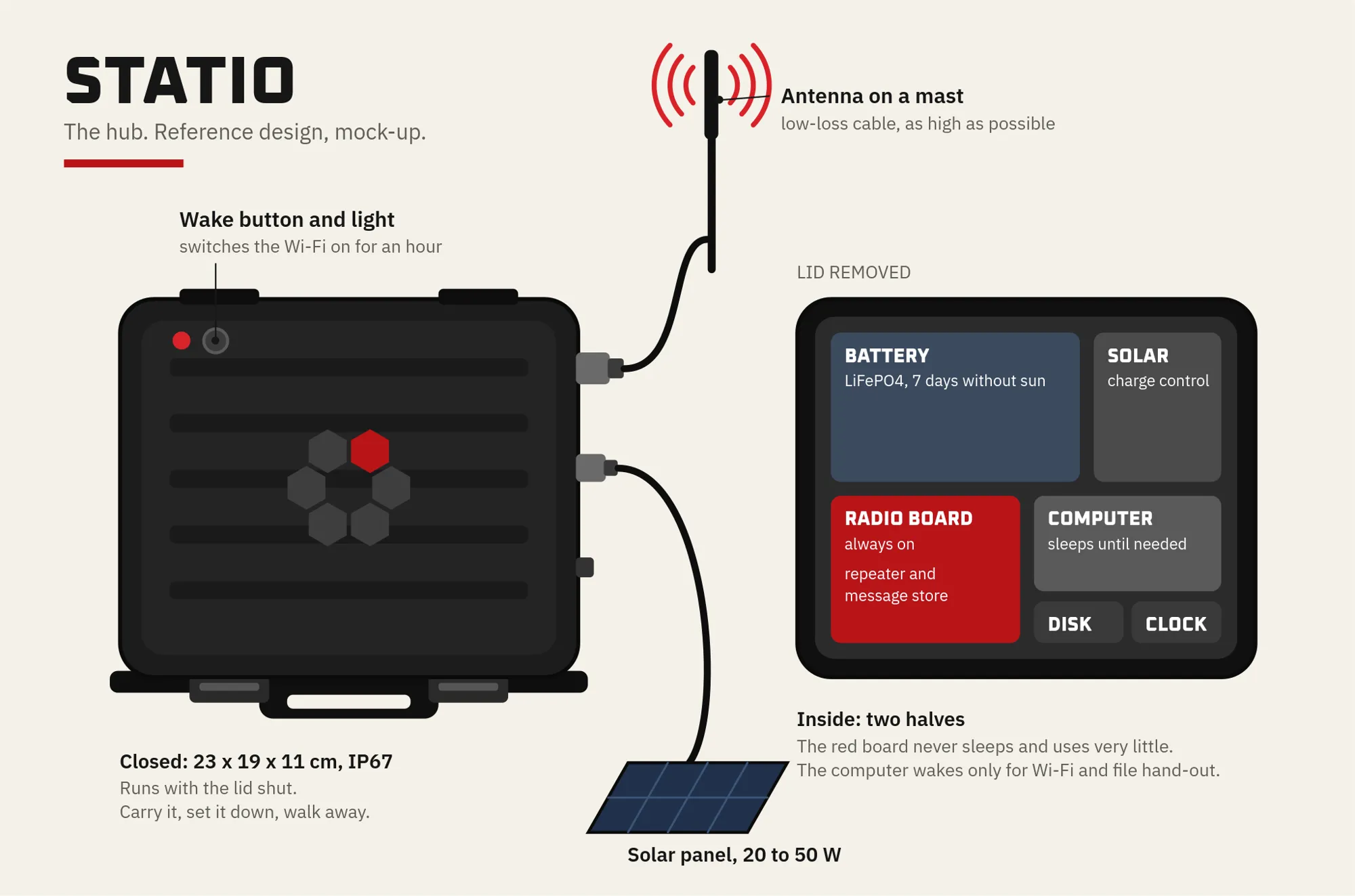
Our hub. A sealed case with a repeater, a battery and a solar input. It keeps messages for members who are out of range, and its local Wi-Fi hands a newcomer the app, the maps and the plan with no internet anywhere. It holds no keys.
The Columen
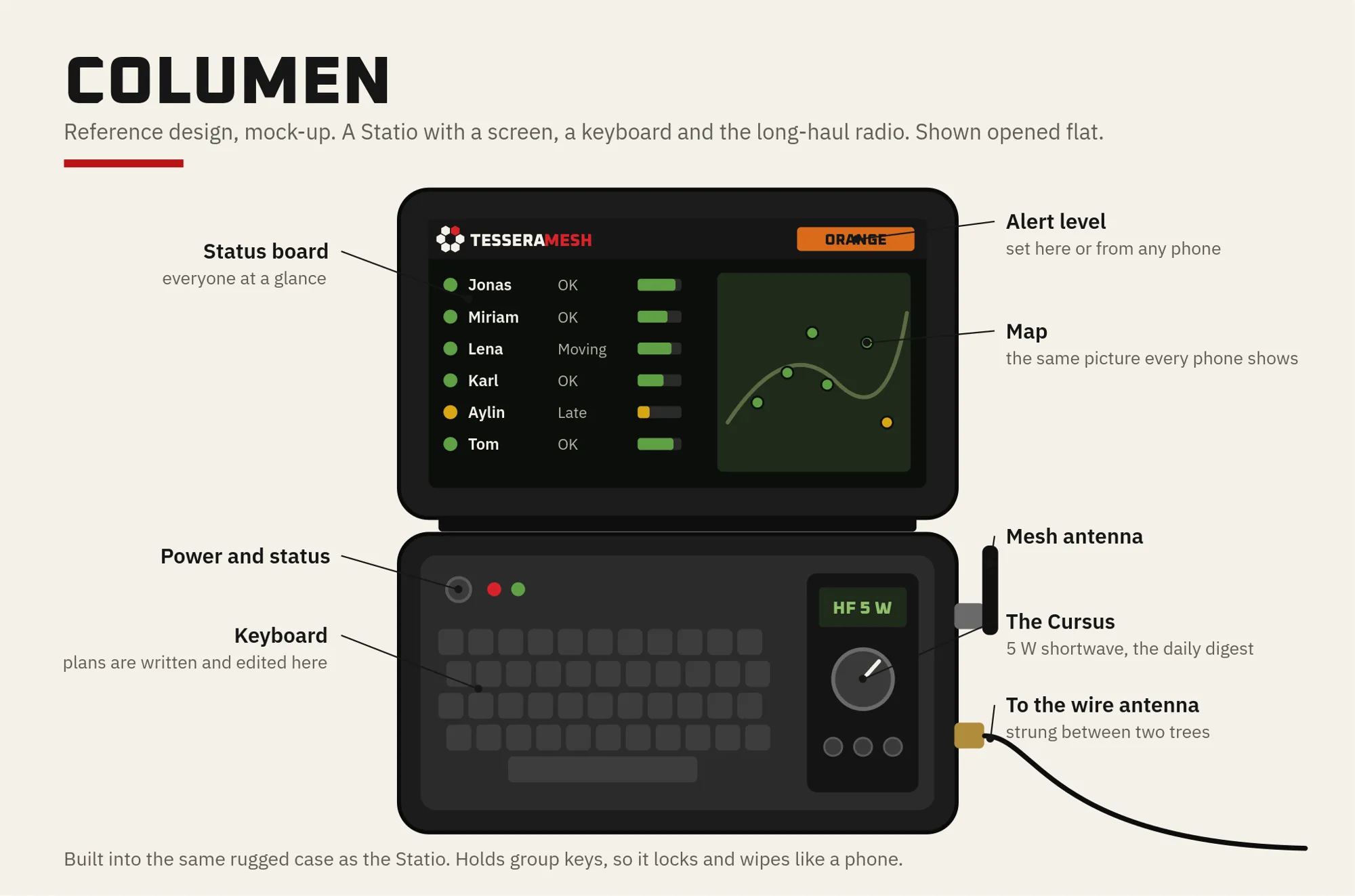
Give a Statio a screen and a keyboard and it becomes the pillar a camp or a street leans on. The board and the map, large enough for everyone to see.
The Cursus
The long line. Five watts, a wire between two trees, and the sky as a mirror. Enough to reach a city hundreds of kilometres away with a daily digest: six of six well, one hurt, tell Anna her father made it.
The Aquila
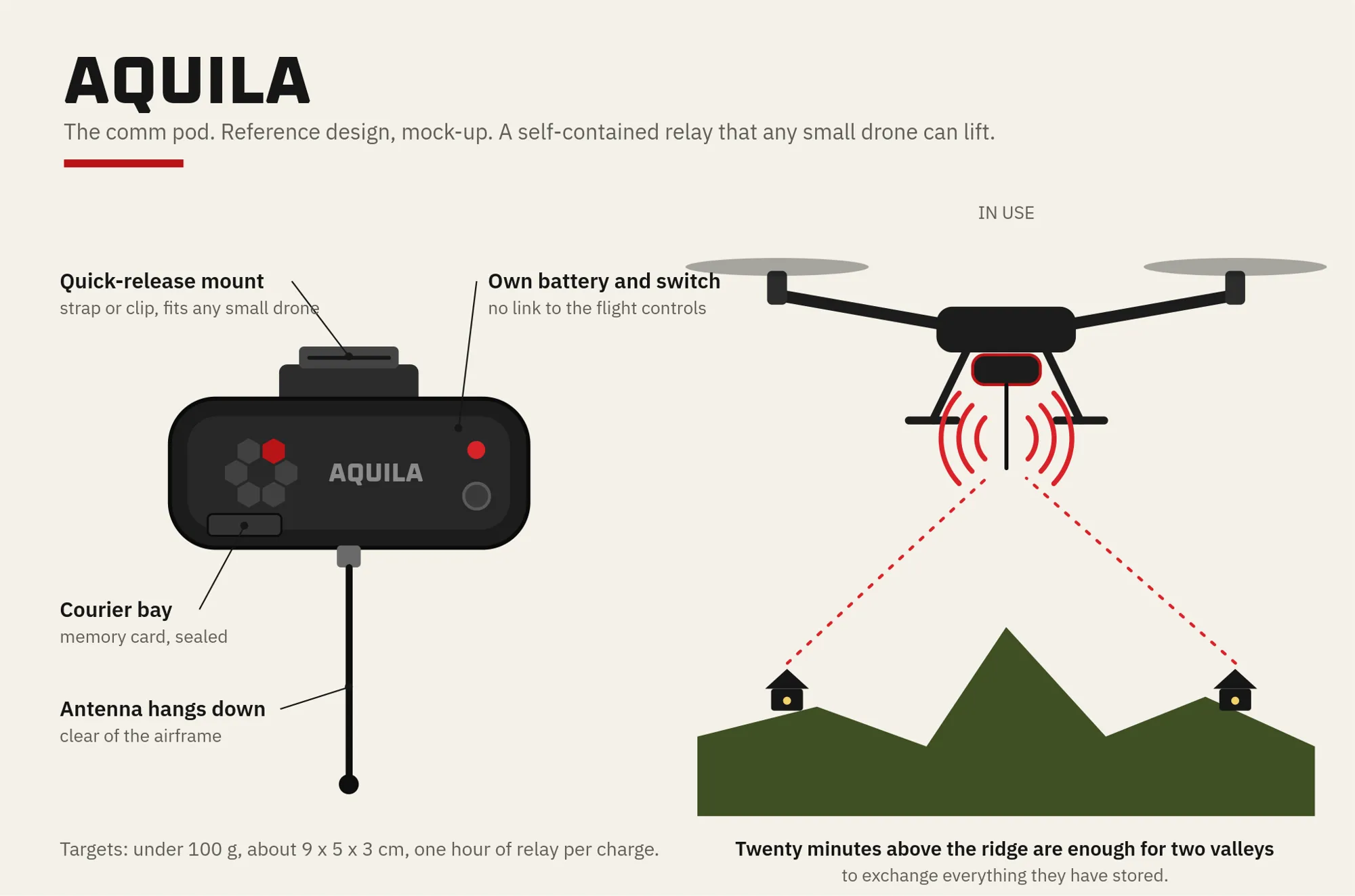
The eagle. A small radio pod that a drone lifts above a ridge for twenty minutes. Long enough for two valleys to trade everything they have stored up.
Vigils
Watchmen. Small boxes that watch one thing and keep quiet until it matters. Water rising in the stream. Bad air in a shelter. A gate opened. Once a day each says "still here", so silence means peace and not a dead battery.
The Horreum
The granary. Everything here runs on the same small cell. The Horreum fills them from sun, car or whatever still gives power, and tells you which ones are tired.
The Tabula
A paper-like screen on the kitchen wall for those with no phone in hand. The colour of the day, who has checked in, the last word from the coordinator. One button: we are fine.
The Carrus
The wagon. A repeater that lives in a car. A convoy brings its own coverage with it, and a car parked on a hill is a Specula for as long as it stands there.
The Pertica
A pole, six metres of it, that folds down to the length of an arm. Range comes from height and from little else. This is the cheapest height you can buy.
The Praeco
The crier. When the internet is gone, governments still broadcast warnings over the air. The Praeco listens and calls them into the mesh, marked for what they are.
Who else can read this? Nobody.
Every message is locked on your phone before it touches the radio, with keys you exchanged face to face. Repeaters, hubs and bridges carry what they cannot read.
Since no key is ever agreed over the air, a recording of your traffic stays worthless, even to someone who one day owns a quantum computer. The keys also roll forward with every message. Steal today's and yesterday stays shut.
One thing cannot be hidden: that you are transmitting. Anyone with the right gear can tell that a radio is on, and roughly where. So there is a radio silence mode in which the app only listens, and the plan can set fixed times to speak.
And if one of you is taken, or turns? One phone holds one member's keys and no more. The group meets, scans new codes, and that phone is outside from then on. Nothing is perfect. But nothing here depends on trusting a company, a server or a government.
What it will not do
- It will not carry voice, photos or video. The radio cannot.
- It will not ask for the internet, an account or anybody's server. Ever.
- It will not let anyone join from a distance. You look people in the eye first.
- It will not replace a paper map, a compass and a group that has talked things through. It makes all three count for more.
What it asks of you
None of this is magic, and it is fair to say what it costs.
An afternoon
And an honest conversation. The hardest part is not the technology. It is sitting down with the people you love and saying out loud what each of you will do when things go wrong.
A tap a month
The roll call at green. Skip it for a year and you will find flat batteries on the day you need them.
Some money
A tracker for each person and a repeater or two for the group. The trackers you can buy today cost around fifty euros each.
Discipline
Airtime is shared, and chatter crowds out the message that matters. A group that treats the radio like a group chat will find it failing them.
Patience with physics
In a city, range may be a few streets. From a ridge it may be tens of kilometres. You will only know after you have walked it.
For the long line, a licence
The Cursus needs a licensed radio amateur at each end. A good reason to make friends with the local radio club now.
Where it stands
Honesty first: all of this is designed and written down, and almost none of it is built. There is a full specification and a printable case for the Tessera. There is no app to download and nothing for sale.
The first step is small. Two trackers, two phones, one afternoon, and the answer to a single question: do our locked messages travel through the radio net the way the design assumes?
And there is something you can do tonight, with no app and no radio. Ask the people you love three questions.
Where do we meet?
Which way do you come?
What do we do if we hear nothing for two days?
Write the answers down. That piece of paper is the first version of TesseraMesh. Everything else only exists to carry it.